Sometimes, but not very often, a road trip comes along, and the route that Google comes up with a route that I was not expecting. This is one of those times! Instead of a route down the coast, we’re going to be headed through the mountains of Appalachia for a day and a half. The drive will cover 767 miles at a pace of a mere 61.5mph. Thanks, mountains! We’ll leave ourselves with a half day after driving 492 miles on the first day.
DAY ONE (Thursday)
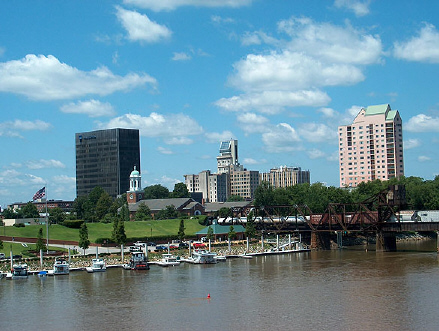
Buffalo, New York
High pressure will be the name of the game on Thursday, keeping any inclement weather at bay. The drive is one in which we will appreciate the dry weather, as moving through the mountains is difficult enough as it is. There isn’t a single straight road in central Pennsylvania or the entire state of West Virginia, which is fun because of the scenery, but less enjoyable when the weather gets a little sideways. It might start to get a bit breezy by the end of the day, and we’ll pull off for the night in Bluefield, West Virginia, which is on the border with Virginia, right before a long tunnel that goes under the state line.
DAY TWO (Friday) The big difference between Thursday and Friday for our little drive will be the terrain. Friday will be a much flatter day. Weatherwise, the big change will be a reduction in the wind. It will be still and pleasant for the duration of our drive, should you be so inclined to pull off at a random road side Waffle House. Or just wait, and get lunch in Florence, it’s only a 4 1/2 hour drive on Friday.
2020 has now surpassed 2005 as the most active tropical season in the North Atlantic in recorded history. We’ve exceeded the total of named storms by two, dipping further into the Greek alphabet than ever before. The long lived Eta has made the most of it’s first appearance in our meteorological lexicon, while Theta is spiraling out by the Azores, and Iota is preparing to landfall in Central America, near where Eta initially exploded on the scene. Similarly, Iota is expected to become a hurricane, with the present forecast asserting that Iota will be a major hurricane upon besetting the Nicaragua/Honduras border with more destruction.
Fortunately, despite all the action this year, we haven’t matched the pace of hurricanes or major hurricanes of 2005, which still holds the record in both categories. A bit of good news is that, at least for the next couple of weeks, it doesn’t look like Iota has a follow up on the immediate horizon, which will make it difficult to reach the hurricane or major hurricane numbers of 15 years ago.
Of course, I say that now, but it should be noted that the Tropical Storm Zeta of 2005, the last storm of that busy year was also the first storm of 2006. In a year like this, there is plenty of time for more new ground to be covered.
I94 WB at exit 201 (Albertville) is closed due to several crashes on I94 near Monticello, a semi is reported on fire – drv is ok. Use alternate routes and drive w/caution on snow covered roads & buckle up. https://t.co/UtVIO3kuBrpic.twitter.com/nFdhh9R2tP
Today, a narrow band of snow swept through the Twin Cities. At one point, the wind and heavy downburst of snow brought I-94 northwest of Minneapolis to a close thanks to a multi-vehicle accident. The Weather Service then issued a snow squall warning, but what is a snow squall, exactly?
In laymen’s terms, I would describe it as something similar to a severe thunderstorm, where the precipitation isn’t necessarily the most noticeable feature to the storm. In the northwest Twin Cities metro, for example, there were 40-50mph winds associated with the quick burst of snow. Buffalo, Minnesota reported 2.5 inches of snow in 90 minutes.
That’s another thing about a snow squall. The “squall” is important, because it is akin to a squall line, as with thunderstorms. There is a leading edge, and a well defined end, particularly as the storm is at it’s strongest. Instead of a bloated mass of snow showers you get with a typical winter storm, it’s a quick, intense line.
The primary impetus for the National Weather Service issuing a snow squall warning is the reduction in visibility, such as was the case in the accident seen above. The strong winds and heavy snow lead to white out conditions, in which visibility is at or near zero. They are targeted like a thunderstorm or tornado warning, to a very specific part of the storm, even if the entire line stretches for a longer distance.
This was Minnesota’s first ever issuance of a snow squall warning. They more frequently appear east of the Great Lakes, and are quite the curiousity in Minnesota.
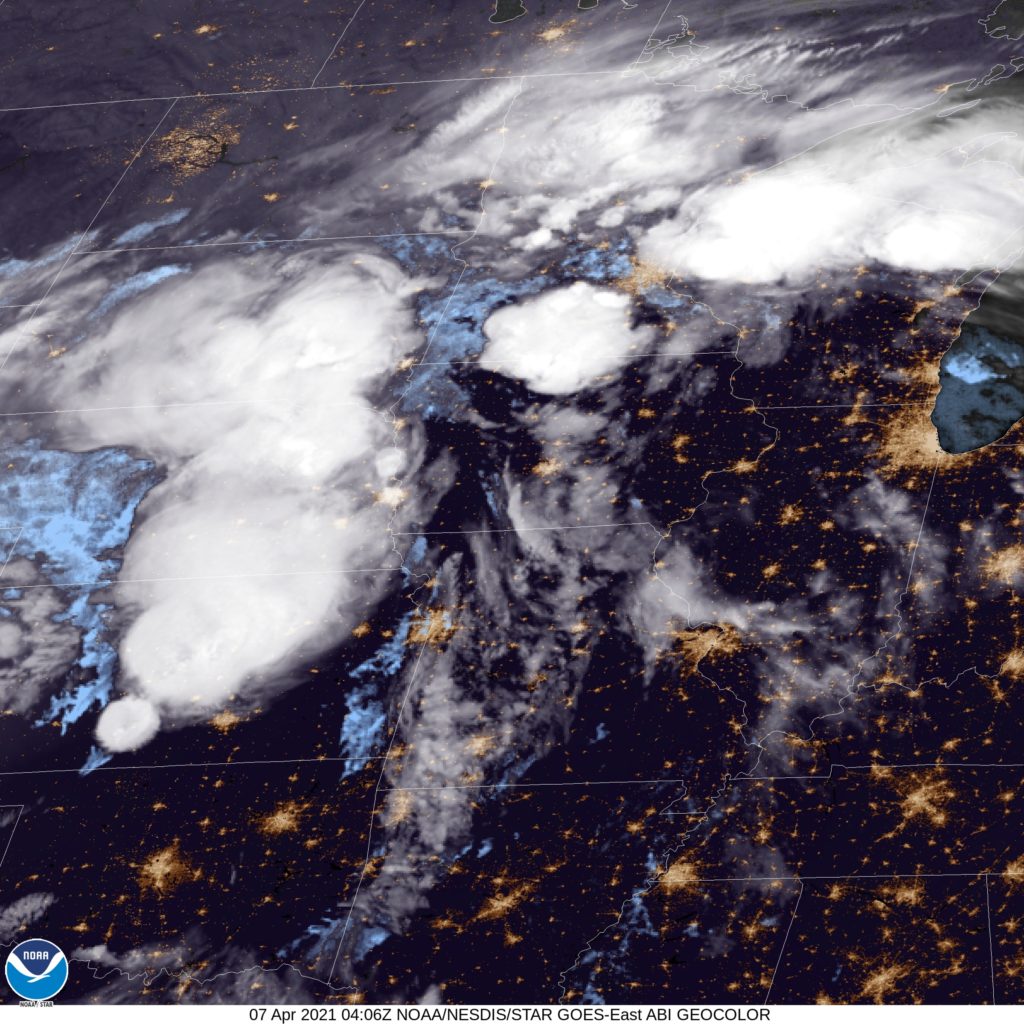
Today was a particularly active weather day, with low pressure in the Upper Midwest extending a cold front through the Great Lakes and on towards the Mississippi. The front itself has been the origin of severe weather from the Quad Cities south through Missouri and eventually across Big Muddy and through Illinois.
More indicative of what’s coming is the snow that fell in the Upper Midwest. 2-5″ fell in Minnesota as precipitation wrapped into the cold air diving into the country behind this system, merely a couple of hundred miles away from tornado warnings in northern Illinois.
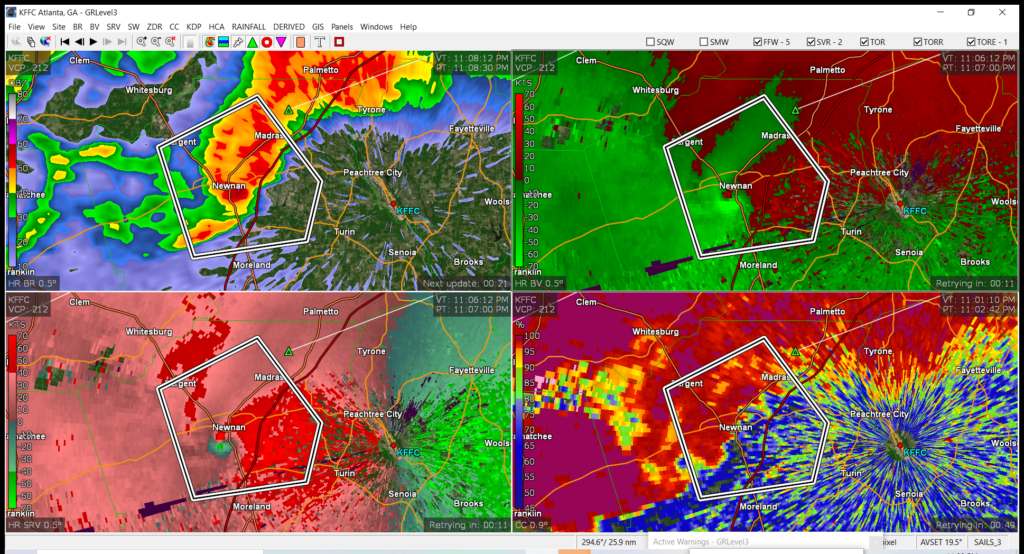
More tangibly, I think these two images spell out the change coming for the end of the week. First, the radar imagery.
And now, take a look at tonight’s lows. There should be some significantly colder air northwest of those bands of thunderstorms.
And there is that sharp drop I promised. High pressure will move in at the surface over the Plains, and prevent much of a warm up for a couple of days. Eta will slow the cold front so all those places that will get copious rain from the tropics will remain warm few days longer.
If you didn’t believe it yet, winter looks like it is here, and will hang on.
Acting as a pretty on the nose metaphor around election day, Hanford was hazy, and didn’t act as expected. An impactful haze settled into Hanford on Monday, keeping temperatures significantly cooler than expected ahead of election day. By the end of the forecast period, though, things fell into place. Weathernation had the top forecast, and it was on the strength of a nearly perfect Election Day forecast. No word on if they have been contacted by any pollsters for 2024. Actuals: Monday, High 71, Low 47 Tuesday – High 80, Low 48
We are only a week into November, which means that we are awarding the forecaster of the month sooner than usual lately, and also, with as long as this week took, it’s clear time has no meaning anymore. The forecasting was pretty ok this month, though it leaned heavily on model guidance because of a west coast bias. It was Accuweather who did the best work for the month.
Hurricane Eta plowed into Central America after exploding from a depression to a Category 5 storm in an alarmingly short time frame. It hit Guatemala, Honduras and particularly Nicaragua with vicious winds, but the particularly brutal part of the storm were torrential rains that killed hundreds thanks to flash floods and mudslides in mountainous terrain. The topography of Central America makes the region a death trap during strong tropical storms.
Now, Eta, instead of expiring in the mountains, turned back to the east and is forecast to wind through the Caribbean, hitting a lot of highlights along the way. Part of the reason it is expected to be able to continue on this path, despite a pending bisection of Cuba tonight, and a graze of the Florida Keys in the early part of the week, is how good it continues to look on satellite.
It’s generated quite a bit of convection to it’s north, and because it isn’t as strong as it looked, it will probably continue to feature broad swaths of directionless convection over places like south Florida as it wiggles along the Gulf Coast.
It’s not going to be a major storm in Florida, but it will last a while and be quite a soaker.
Late October was alive with nasty weather, and the Pacific Northwest was not spared. Despite it’s position on the drier side of the Cascades, even Wenatchee saw a rain/snow mix on Friday the 23rd. This was well anticipated, but the clouds that suppressed temperatures on Friday were not as well foreseen and sunk a few forecasts. The outlets that had cooler highs also correctly called for snow, and snagged the best scores. At the top of the heap was WeatherNation. Actuals: Thursday 10/22, High 50, Low 36 Friday – .06 inches of precipitation for rain/snow, High 36, Low 31
Let’s do an Election Day forecast, shall we? In the parlance of politics, we’ll head from one blue state to another, but we’ll travel through some red states along the way. It will take 4 days, or about as long as it will take to count all the votes, to cover 2107 miles. The fourth day will be slightly shorter than the first three, with those first three days concluding after 544 miles of driving at around 68mph. Most cars can stream audio now, so maybe avoid the AM radio and just enjoy the open road for this trip.
DAY ONE (Wednesday)
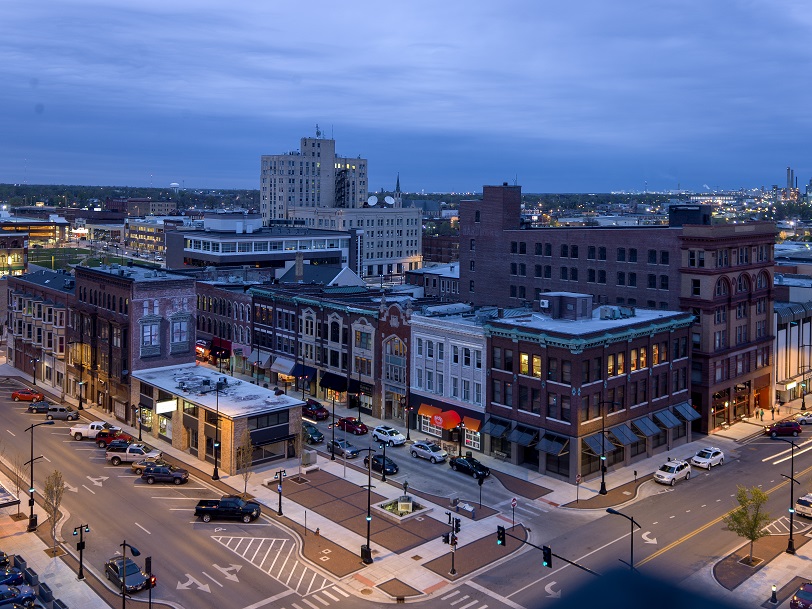
Champaign, Illinois
As the jet has drifted back a bit to the north, things have started to warm up for the middle of the country, and our drive on Wednesday can likely be done with the windows down if the car gets too stuffy. There won’t be much weather to remark on, save for breezes that could gust to 15mph at times. Noting treacherous. We’ll arrive in suburban Tulsa for the night.
DAY TWO (Thursday) Thursday will be similar to Wednesday, though with a diminished chance of a prevailing wind. We will drive through central and western Oklahoma, still cleaning up after a calamitous ice storm, and pass through the Texas Panhandle into New Mexico under sunny skies. We will stop at the San Ignacio exit west of Santa Rosa and completely be out of touch with the rest of civilization.
DAY THREE (Friday) As we approach California, we will do it through the desertified parts of the Southwest. New Mexico and Arizona will remain clear and dry, but a system moving into the West Coast will stir some winds inland. Watch for tumbleweeds in this part of the world. The drive will end at Silver Spring Road between Kingman and Seligman in Arizona.
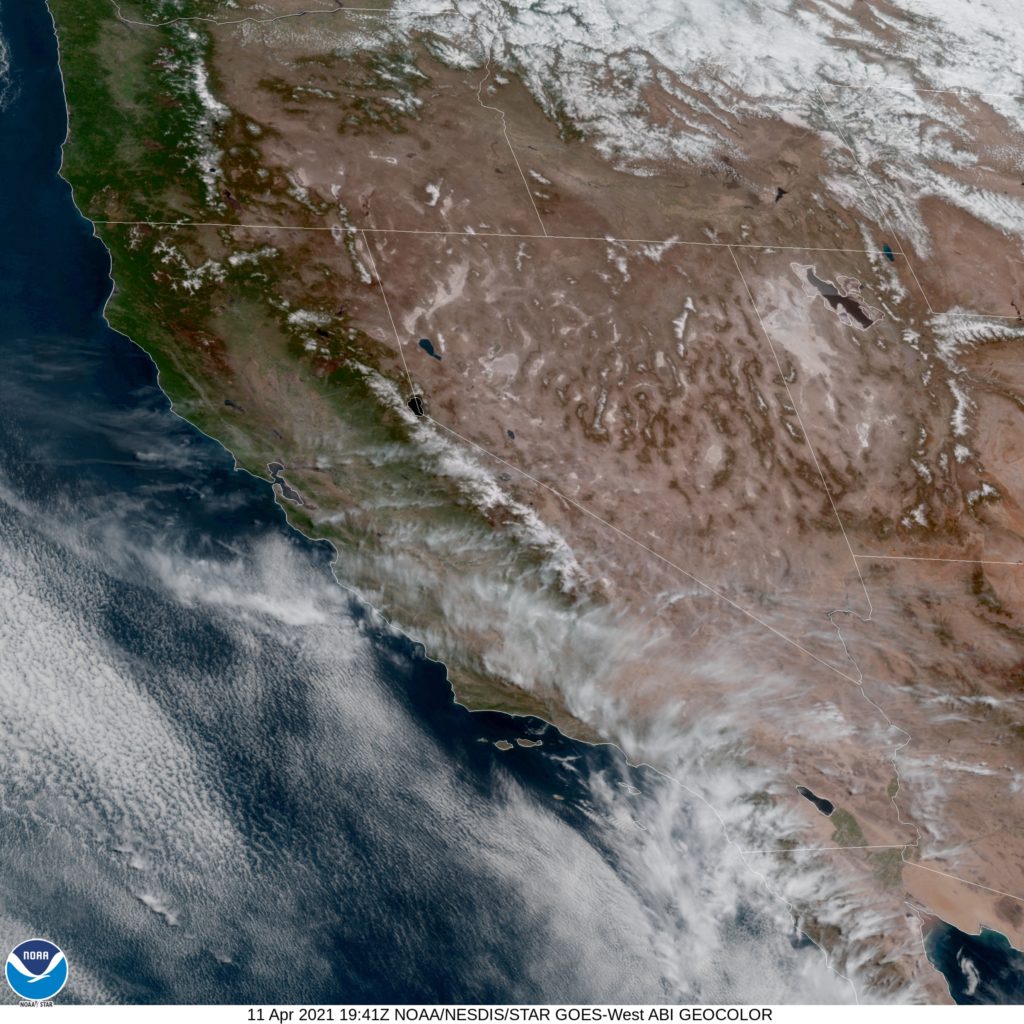
DAY FOUR (Saturday) As is often the cast, the feature moving into the West Coast will lose a lot of structure as it gets into the mountains, but that doesn’t mean it will be completely obliterated. In fact, well defined fronts will still exist, including a cold front we will drive though in southern California. That’s not to say it will be particularly rainy, if at all, as the frontal passage will be between Barstow and Mojave, right in the heart of the desert. When we descend into the central Valley at Bakersfield, we’ll probably get into some soupy overcast with drizzle. Expect that right on down to Hanford. Strange, right? The only part of the trip with rain will be the part in California.
Hanford, California
By Armona at en.wikipedia, CC BY-SA 3.0, https://commons.wikimedia.org/w/index.php?curid=17978087