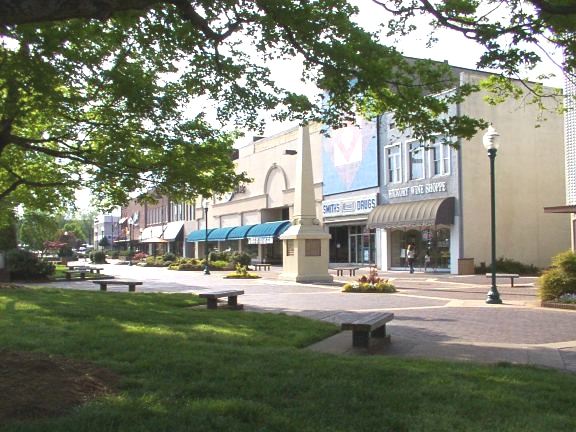
We looked at Evansville early last week, when bundle of low pressure moving through the Great Lakes promised to disrupt some outdoor plans. Indeed, it did, but fortunately for everyone working at home, the rain came only on Wednesday the 29th of April, so Tuesday was pretty nice. Ahead of the low, warm air surged into Indiana to make it even nicer. Forecast.io came through with the victory, so I’m sure they thought it was especially nice. Actuals: Tuesday April 28th, High 76, Low 57 Wednesday, April 29th, .2 inches of rain, High 67, Low 49
Models have been in the news quite a bit over the last several weeks, in particular as they relate to the COVID-19 Pandemic. There have been a great deal of concerns and questions as they relate to scientific modeling. I’m certainly not an epidemiologist, but meteorology is a field of science that relies heavily on modeling, so I thought I might share some insights.
Models, depending on the output desired, are essentially mathematical equations, in which variables are either solved for or assumed. The equations are given starting information, which is often altered, depending on observations, such as the temperature or barometric pressure in meteorology, or the case total or fatalities in a COVID model.
There is often discrepancy in the models versus what happens in real life because variables can be uncontrolled. In the case of the weather, the limited number of observations means there are gaps in information that are assumed, but not confirmed, which can lead to errors, especially over time.
The same can be said with COVID modeling, however the assumptions are based on how people will respond. The primary difference, at this point, between the various COVID models is assumptions based on how government ordered social distancing is instituted and remains in effect. One of the uncontrolled variables is how engaged in the population is in the social distancing, as the models only respond to the virus’s known rate of spread and mortality.
Models are only as good as the information that goes into them, but at the very least, they are effective at demonstrating trends, and giving an idea generally, if not always specifically, of the future. They can inform of responses of changes in variables. Weather models are updated regularly, and resubmitted with new data, with corresponding alterations to the forecast. COVID models are updated with new case numbers and new actions by the local populations and government.
Models exist to allow the public and the various powers that be to prepare and respond to pending conditions, whether they be thunderstorm or waves of illness. Unlike weather modeling, in which we are tasked with responding to the output, epidemic modeling allows us to alter the outcome with our actions, and are of particular value.
One of the thing that tempers the opinion of this nascent cooldown east of the Rockies, is that the past few weeks, especially towards the Plains and Mississippi Valley have been very pleasant. Take Des Moines, where some thunderstorms on the 22nd and 23rd, during our forecast period, had the courtesy of falling overnight, and highs rose to the upper and mid 70s, outpacing forecasts ever so slightly. The Weather Service had the top forecast, though many outlets were punished for failing to mention the threat of wet weather. Actuals: Wednesday April 22nd, Trace of rain, High 78, Low 51 Thursday April 23rd, Trace of rain, High 74, Low 52
The last couple of years have seen April’s with historic late season snow storms that called into question the true definition of spring. This year, it’s bee significantly warmer, and dare I say spring like for a lot of the country. This as been with it’s negatives, of course, as the spring severe season has been particularly robust in the Southeast, but I think a lot of people are pretty pleased with how the weather has turned out in April.
The CPC would like to end your celebrating.
A large portion of the country, centered around the Great Lakes, is going to start May much cooler than normal. It probably won’t mean snow, but it shouldn’t be ruled out everywhere. Conversely, temperatures in the southwest, which have already been well above normal, are expected to continue to be significantly warmer than normal. Nobody is happy.
On the plus side, at least out east, is that cooler temperatures are more tolerable in May than they are in April. Additionally, cooler temperatures should help mitigate the severe season in the southern Plains. The first week of May has historically been a dangerous week in Oklahoma, but that doesn’t seem to be the case this year.
For warm weather lovers, the long range forecast isn’t great, but it could all certainly be worse.
You know, we talk a lot about how nasty the weather is in most of these posts, but let’s take note of how fine the weather was in Sacramento last week. We issued a forecast at the beginning of the week for Tuesday and Wednesday, and the weather was delightful. The forecasts were very good as well, with a triple threat tied for the forecast win: The Weather Service, The Weatherbug and The WeatherNation. Actuals: Last Tuesday – High 78, Low 47 Last Wednesday – High 82, Low 52
I used to live in the northern part of Indiana (I went to school there) but I’ve never made it down to Evansville. One of my best meteorology friends is from Evansville, though, so maybe this forecast will get a cosmic boost because of that.
At 1154PM, CT, Evansville was reporting few clouds with a temperature of 57 degrees. The regime was mostly southerly, thanks to a warm front emerging on the Wisconsin/Illinois border. While the southerly flow is impacting Evansville now, the continued development of this feature will mean more significant weather later in the week. Notably, after a daylong warm up tomorrow, the cold front, materializing through the day on Tuesday, will arrive late in the evening. Rain and thunderstorms, some of which could contain hail or strong winds, will be possible. After the front passes, the parent low will begin to occlude and meander through the Great Lakes as it takes a left turn towards eastern Canada. Rain will continue to wrap around the circulation, even as the cold front presses to the east. A positive benefit is that temperatures won’t dip too far on Wednesday, thanks to the cloud cover, but the steady light rain will make the day too gloomy to see that silver lining. Tomorrow -Warm and mostly sunny, with strong thunderstorms possible late, High 76, Low 55 Wednesday – Heavy early rain, then mostly cloudy with rain possible through the day, High 62, Low 48
TWC: Tomorrow – Cloudy skies early will become partly cloudy later in the day (Late thunderstorms). High 76, Low 56 Wednesday – A steady rain in the morning. Showers continuing in the afternoon. Thunder possible High 64, Low 51
AW: Tomorrow – Mostly cloudy and breezy (dangerous thunderstorms late) High 73, Low 56 Wednesday – Cloudy, breezy and cooler with showers High 62, Low 52
NWS: Tomorrow – A 20 percent chance of showers before 1pm. Mostly cloudy, (storms late) High 74, Low 55 Wednesday – Showers, with thunderstorms also possible after 1pm. High 66, Low 52
WB: Tomorrow – Partly sunny (late storms), High 73, Low 57 Wednesday – Showers in the morning then showers and a slight chance of thunderstorms in the afternoon, High 64, Low 52
WN: Tomorrow – Partly cloudy with isolated showers, High 74, Low 56 Wednesday – Mostly cloudy iwth light showers, High 66, Low 57
FIO: Tomorrow – Partly cloudy throughout the day. High 77, Low 55 Wednesday – Rain throughout the day. High 66, Low 50
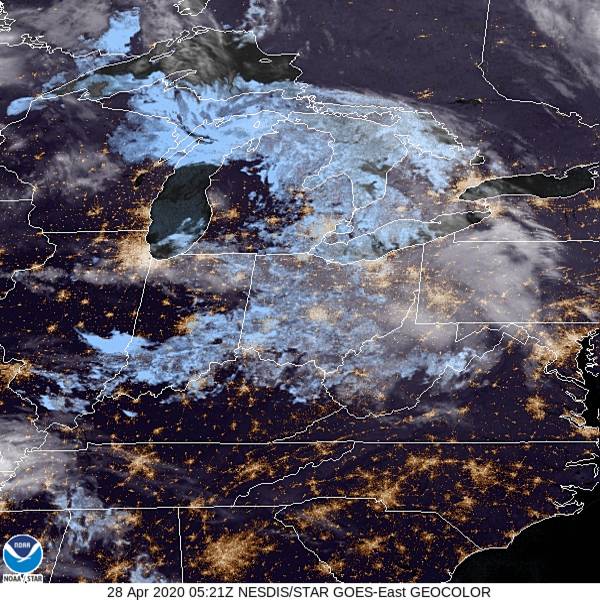
FIO’s timing is slower and I fear that may do them in this forecast, but I always appreciate their temperature forecasts on non-standard days (which is what will happen on Wednesday). 24 hour highs and lows. A look at the satellite shows the remnant of an unmentioned area of low pressure. The real focus is the next one for Evansville.
A large area of low pressure moving through your area is usually a recipe for a botched forecast. That wasn’t the case at the beginning of last week in Hickory, where as we issued the forecast, the western North Carolina town was at the beginning of what would be 7/10ths of an inch of rain. Despite that, forecasts for the two days were collectively very good. Maybe because the rain was over well before noon on Monday. Accuweather and the Weather Service tied for the top forecast. Actuals: Monday – .7 inches of rain, High 68, Low 49 Tuesday – High 73, Low 45
At 854PM, CT, Des Moines was reporting a temperature of 58 degrees with clear skies. There was certainly a warm front just to the west, as even at this hour, Lincoln, Nebraska was sitting in the low 70s. Low pressure further to the south was intercepting any moisture, so the warm air will lift into Des Moines overnight without much impact. The southern low will shift eastward and remain south of of the Hawkeye State. Some moisture folded into the feature will wrap back to the north during the day tomorrow and lead to overcast skies at times with some light drizzle. The feature will shift further east overnight Wednesday into Thursday, with dryer air building in for a sunny day on Thursday, though late in the day, another trough will begin to drift in from the west. This will be weaker, but with better access to moisture for the Des Moines area than the two features previously, and some late rain or thunder are possible Thursday night. Tomorrow – Mostly cloudy to overcast, with a chance for drizzle. High 76, Low 48 Thursday – Very early and very late rain possible, but sunny during the day, High 68, Low 50
TWC: Tomorrow – Partly cloudy with afternoon showers or thunderstorms High 76, Low 51 Thursday – A few passing clouds, otherwise generally sunny High 70, Low 48
AW: Tomorrow – Some sun, then turning cloudy, breezy and warmer (Late rain) High 74, Low 50 Thursday – Some sun, then turning cloudy, breezy and warmer High 70, Low 50
NWS: Tomorrow – A 40 percent chance of showers and thunderstorms, mainly after 3pm. Partly sunny, High 76, Low 49 Thursday – Mostly sunny (Late rain) High 70, Low 49
WB: Tomorrow – Partly sunny with a 40 percent chance of thunderstorms. Warmer. High 71, Low 50 Thursday – Mostly sunny (thunderstorms early and late) High 69, Low 51
WN: Tomorrow – Partly cloudy with scattered storms, High 76, Low 49 Thursday – Partly cloudy, High 70, Low 49
FIO: Tomorrow – Partly cloudy throughout the day. High 76, Low 51 Thursday – Partly cloudy throughout the day. High 73, Low 51
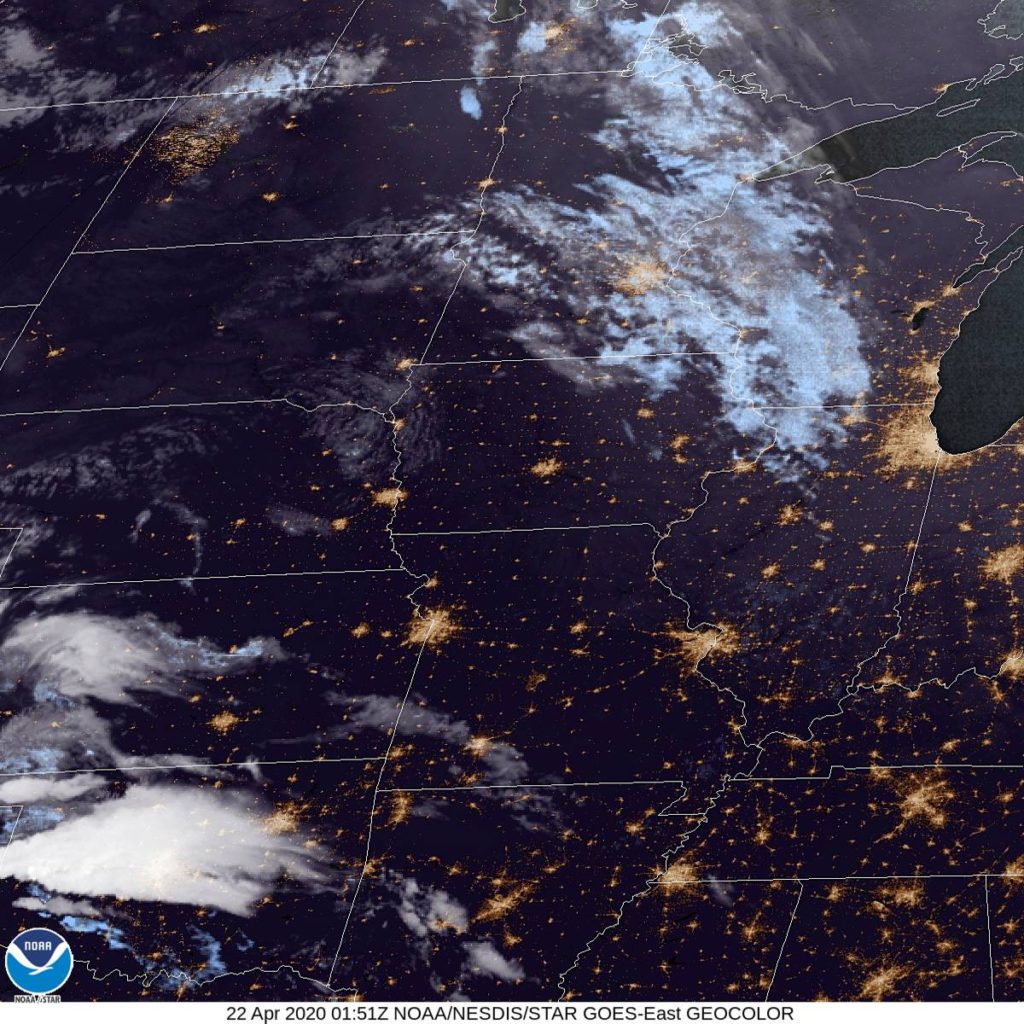
Here is the night’s satellite, showing Iowa to be nice and clear tonight.
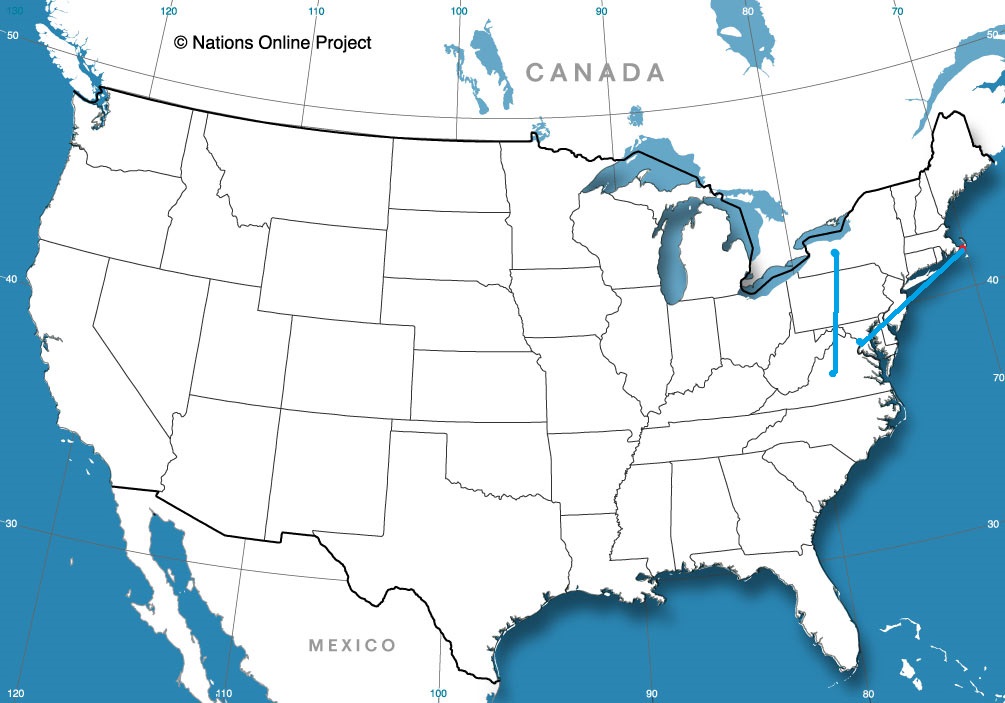
In the coming days, our forecast trajectory will take us into the mid-Atlantic and southern New England. We will also be sure to take care to discuss the ongoing spring severe season, which we will be reminded of, undoubtedly, in the next few weeks.
Barnstable, Massachusetts Road Trip from Washington, DC to Barnstable
Road Trip from Rochester, New York to Charlottesville, Virginia
I-40 runs all the way from North Carolina to California, and yet we will spend the first part of this trip getting up to I-80. The drive will be a 5 day excursion that covers 2,635 miles. Our 5 days will be evenly spaced at 527 miles a day. or rather just short of 66mph. We have some ground to cover, so we should probably get a move on.
Hickory, North Carolina
DAY ONE (Tuesday) A weak tail of a cold front will be sweeping through the Appalachians overnight tonight. Could there be a little bit of mountain snow in the Appalachians. It will probably be only rain along our route through the mountains, as it will likely only be possible on the west side of the hills. Rain might be a possibility all the way to Crossville, but expect cool and dry air to move in by the late afternoon as we touch two more states, Kentucky and Illinois, where we will stop in Vienna, in far southern Illinois.
DAY TWO (Wednesday) A little bullet of low pressure is going to arise in the southern Plains and move through the central US. The warm front will be a traditional stratiform rain maker, just like we want to see in the spring and summer months. That is to say, no severe weather and no snow. We’ll be in the rain for most of the time spent in Missouri. Rain will lighten north of about St. Joseph but there will certainly be some lingering sprinkle activity north to Nebraska City, along the Iowa/Nebrasla state line.
DAY THREE (Thursday) The weather will become more congested as we head west. Nebraska looks like it will be pretty OK as we move along I-80, but don’t be surprised if an emerging feature brings some light ran to our drive after we pass into Wyoming. We’ll make it to Turtle Rock in the midst of a National Forest between Cheyenne and Laramie.
DAY FOUR (Friday) Some atmospheric troughing will continue over the Wyoming Rockies, and a splash of rain with maybe *MAYBE* some snow in the peaks will accompany our trip along I-80 in Wyoming. Utah will be a different story as the Great Basin will be bathed in sunlight. It will work out just so that our day will end in West Wendover, Nevada, right along the UTah border.
DAY FIVE (Saturday) What better way to finish a long week of driving than with a bright, sunny drive without the threat for inclement weather. Truckee and Lake Tahoe can be a bear when the weather is active, especially this time of year, and we just won’t have anything to really worry about. Sunscreen, maybe, if you want to go out while you are in town.