
As we sit on the final day of June, awaiting the beginning of July, the pattern has certainly taken a turn for summer. The spring season is marked by strong cyclones and supercells that bring tornadoes to the southern Plains and Dixie Alley. It rightfully gets a lot of attention for the destruction and disruption it can bring.
Spring storms are brought by the changing airmasses, from cool and dry winter to hot and humid summer. Eventually, summer takes hold and it just gets incredibly hot and humid in the South. There are a few afternoon thunderstorms, essentially every day, but they are fueled directly off of one air mass, and not a clash. That’s where we are now, it’s overwhelmingly hot, especially in the southeast.
This is also the time of year where fuel for thunderstorms is the greatest, so whenever flow is from the west, and we get low pressure in the lee of the Rockies, we can get strong to severe thunderstorms in the Plains. This isn’t necessarily colder air, just drier air, but this burst of energy can ripple through the atmosphere, and the weakest of boundaries offer as firing lines for thunderstorms to ride along.
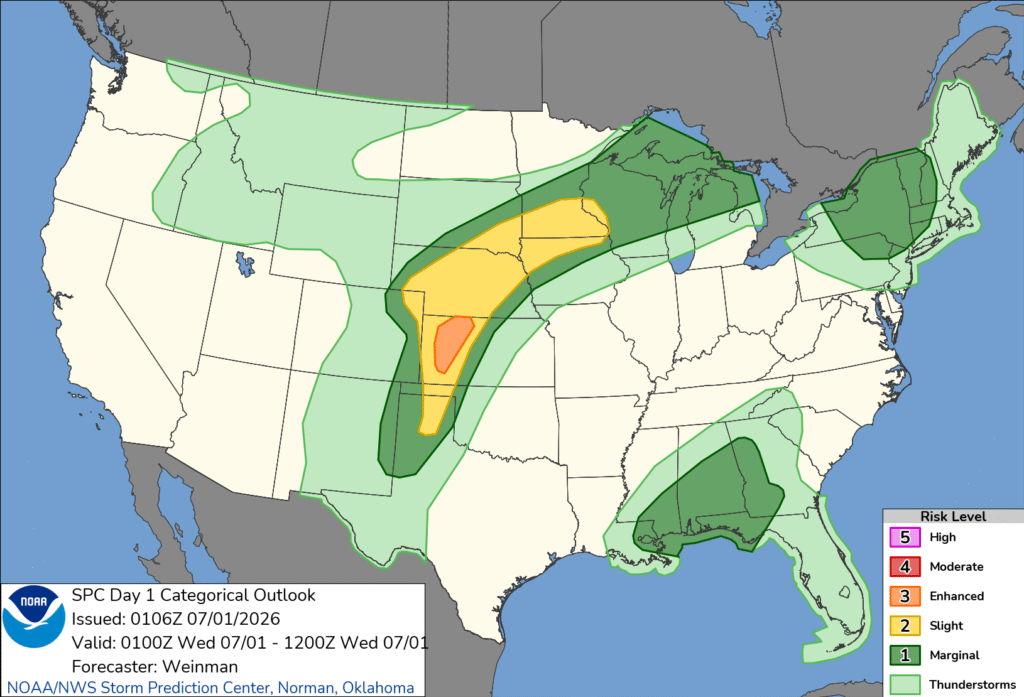
Tonight’s outlook shows exactly what a typical summer time severe set up should look like. There is the origin of the storms in western Kansas, where they may get a bit twisty, with tornadoes more likely. From Nebraska to Minnesota, one of those ripples in the air mass will act as a guide for a batch of storms with howling straight line winds – a true derecho. It’s almost midnight, and it is producing nearly 80mph winds in central Nebraska.
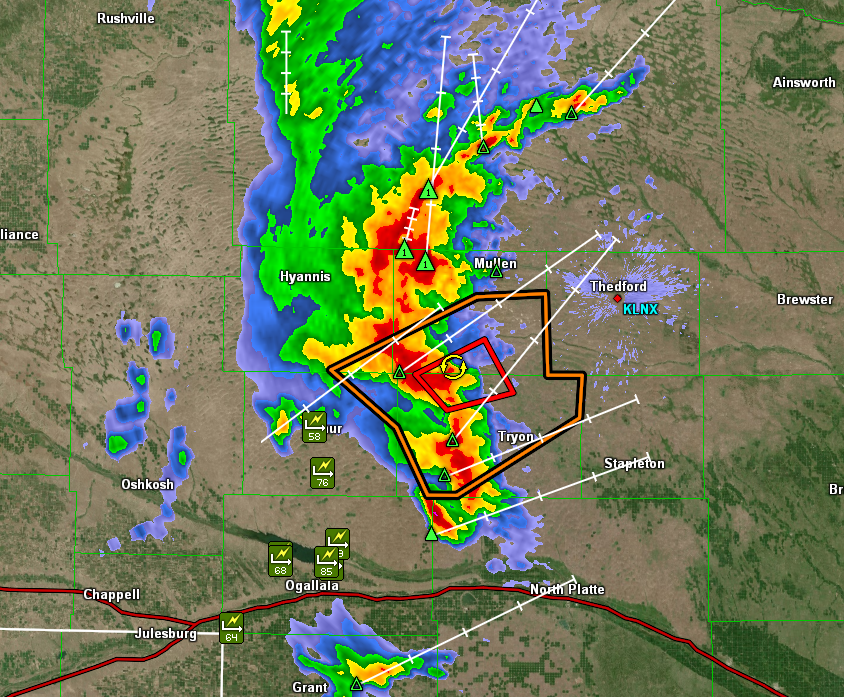
Often times, there are embedded tornadoes within squalls like this, but really, a tornado warning might just be what it takes to pay attention to a storm that will mess things up pretty well on its own.
Given the copious amounts of fuel on hot humid days, long track derechos are more likely. Even if they are derechos, lines of thunderstorms occur more frequently than the cellular storms of spring. Even in New York a line of storms is moving through upstate New York, feasting on the atmospheric moisture, rather than conflicting airmasses.
Storms like our Nebraska storm, above are also called mesoscale convective complexes. Our air mass storms in the southeast erupt when surface heating reaches a point that causes the moist air to become buoyant, rising, condensing and forming cumulonimbus clouds and eventually, thunderstorms. Those are the same mechanics for our storm in the Plains to initiate, but there is a different mechanism for its sustenance.
As I hope you have learned by now, warm or moist air rises. Typically, this is the surface warming up, but overnight, especially with the elevated thunderstorms we are seeing, cooling from the top down after nightfall is what draws those parcels of air upward. They continue to track along whatever phantom boundary, or wave or ripple exists, and they tend to roll on until that boundary tapers away.
Our Nebraska storms show no signs of dying out quite yet. Look for a loud wake up in Sioux City Iowa and Rochester, Minnesota.